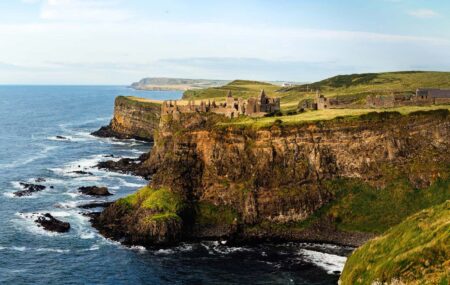
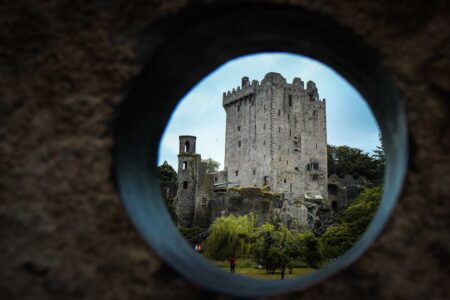
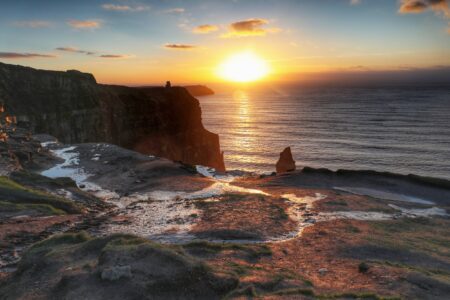
Connemara and the Burren sit on either side of Galway, on Ireland’s west coast and some of the favourite stops along our Classic Wild Atlantic Way tour.
If you were to do Connemara and the Burren on an isolated self-drive tour then a nice self-drive loop links Galway city, Connemara’s Sky Road and Kylemore Abbey, then crosses to the Burren’s limestone pavements and the Cliffs of Moher in County Clare. You should allow two to four days for this driving loop, although most people will explore Connemara and the Burren as part of a longer self-drive tour of the Wild Atlantic Way such as our 5 night Taste of the Wild Atlantic Way.
At Celtic Routes, we plan many of these trips each year, and we have driven every stretch of the route ourselves. What follows is the drive as we would set it up for you, section by section, with the distances, the timings and the stops we point people towards when they ask what we would do with the days. It is written as a drive rather than a geography lesson, because that is how it is best understood. The two regions look very different from the road, and the pleasure is partly in the contrast: Connemara’s mountains, bogs and inlets to the north, the pale limestone of Clare to the south.
Quick facts: the Burren at a glance
- The Burren is a karst limestone landscape of roughly 360 sq km in County Clare. Its name comes from the Irish Boireann, meaning “a rocky place”.
- It forms the northern part of the Burren and Cliffs of Moher UNESCO Global Geopark, which covers around 530 sq km in total.
- Poulnabrone Dolmen, the Neolithic portal tomb at its heart, is more than 5,000 years old. It predates the pyramids at Giza.
- The Geopark is home to 23 of Ireland’s 27 native orchid species, with Arctic, Alpine and Mediterranean plants growing side by side on the same bare rock.
- Doolin Cave holds one of the largest free-hanging stalactites in Europe.
Where Connemara and the Burren actually sit
Galway is the natural base for both and is a 2.5 hour or roughly 200km drive from Dublin along the M4 and M6 motorways. If you’re travelling from Shannon airport the drive will take a little over an hour to cover the approximately 90km to the city of Galway.
It helps to picture the geography before you set off. Connemara spreads north and west of the city, a wild sweep of mountain and coast reaching out towards Clifden and Roundstone. The Burren lies in the opposite direction, south across Galway Bay in County Clare.
That shapes the whole itinerary. You do not drive from one straight into the other. You explore Connemara, come back through Galway, then head south into Clare. It is not a detour so much as the honest shape of the route, and knowing it in advance means you plan the days properly rather than doubling back tired on the last afternoon. Think of it as a figure of eight with Galway at the centre.
Start in Galway
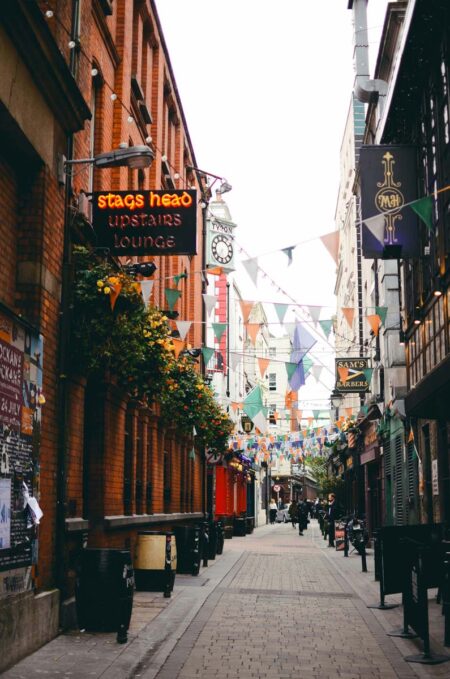
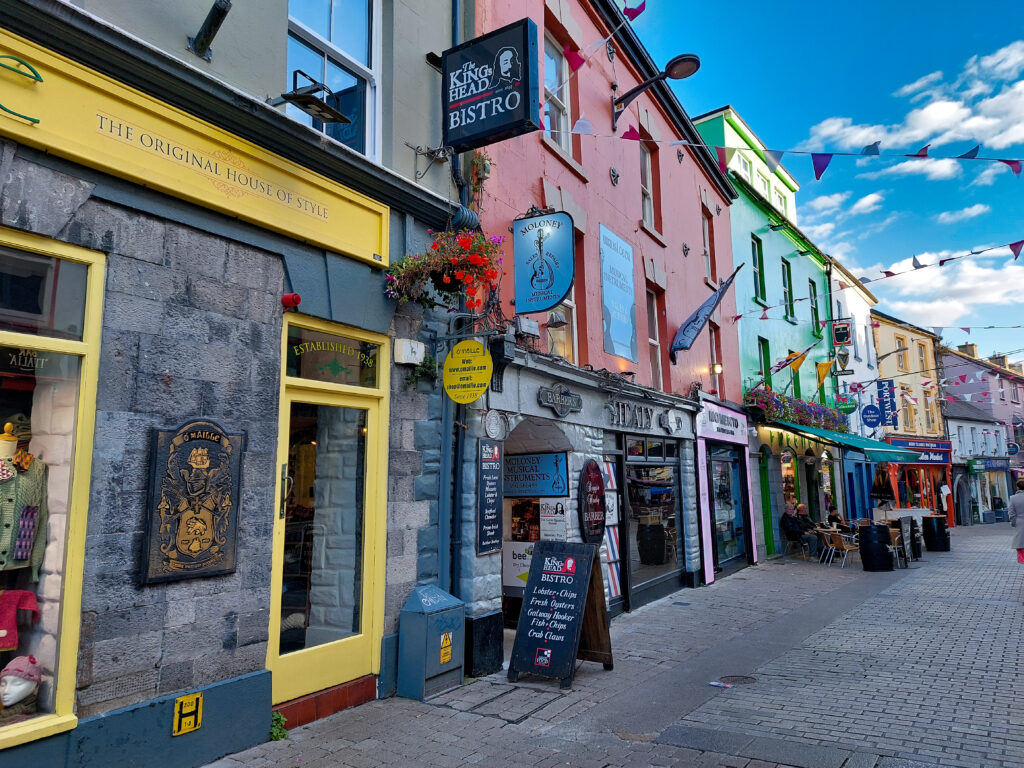
It would be a mistake to treat Galway as merely the place you collect the car. Give it an evening either side of your drive and it will earn the time. It is a compact, walkable city, and its pleasures are the unhurried kind. Wander down Shop Street and Quay Street through the Latin Quarter, where buskers play in the doorways and the pubs spill traditional music onto the pavement most nights of the week. Follow the river to the Spanish Arch and the old Claddagh, the fishing quarter that gave the Claddagh ring its name, then out along the Long Walk with its line of painted houses reflected in the water. There is Galway Cathedral to look in on, Eyre Square to sit in, and some of the best seafood in Ireland to be had, the Bay’s native oysters chief among them if you are here in season. Galway wears its reputation as the cultural capital of the west lightly, and a good dinner followed by a session in a snug bar is the ideal way to bookend the wilder days on the road.
How long to give it
Two to four days is the sweet spot. You can technically see the headline sights in a single long day of driving, but we would gently talk you out of it. Connemara alone rewards a slow morning, and the Burren is a place you feel rather than tick off. Three days is the version most of our travellers settle on: two for Connemara, one for the Burren and the Cliffs of Moher, with the drive back through Galway built in. If you have half a day spare, the city of Galway itself is worthy of exploration.
Discovering Connemara and the Burren can be included in any of our Ireland tours.
Galway into Connemara
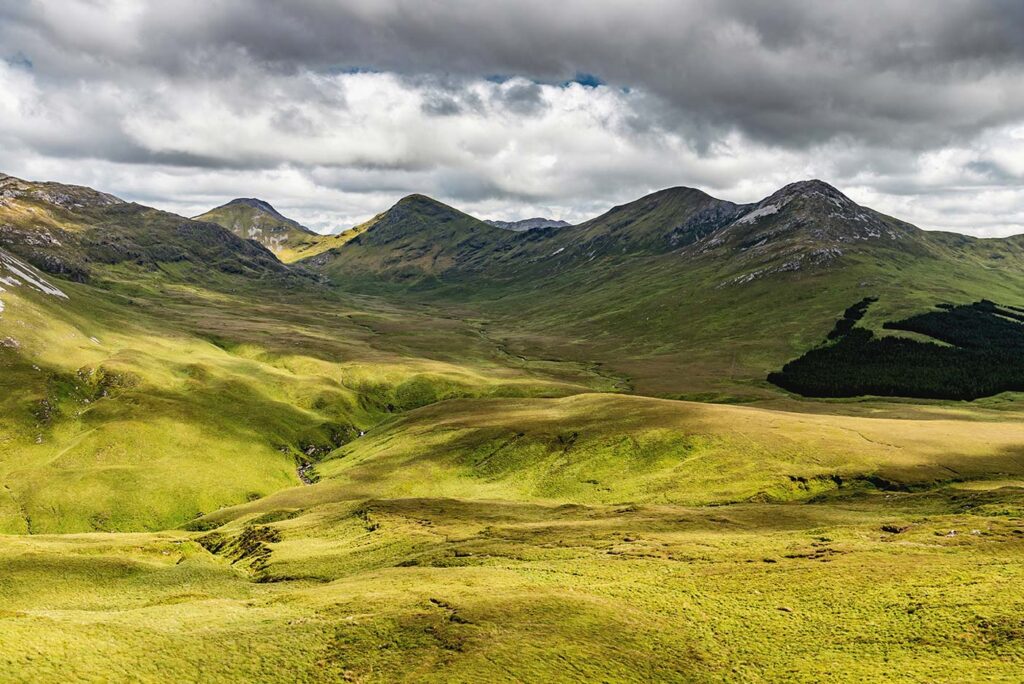
The road west is the N59, and it changes character within twenty minutes of leaving the city. Not far from the city and a minute from the N59 is the Quiet Man Bridge from the classic Irish film. The bridge is where Sean Thornton tells Michelean Flynn why he has come back to Ireland.
Shortly after you pass Oughterard, then the open bog and lake country around Maam Cross, where the Twelve Bens (Na Beanna Beola in Irish) rise ahead of you. It is around 80 km from Galway to Clifden, a little over an hour if you drove it without stopping, which nobody sensibly does.
Clifden is often called the capital of Connemara, a small Victorian town tucked between the mountains and the sea. From here we would send you out on the Sky Road, a short signposted loop that climbs above the harbour and gives you the coastline, the islands and, on a clear afternoon, a horizon that seems to go on forever. It takes half an hour to drive and considerably longer if you keep stopping, which you will.
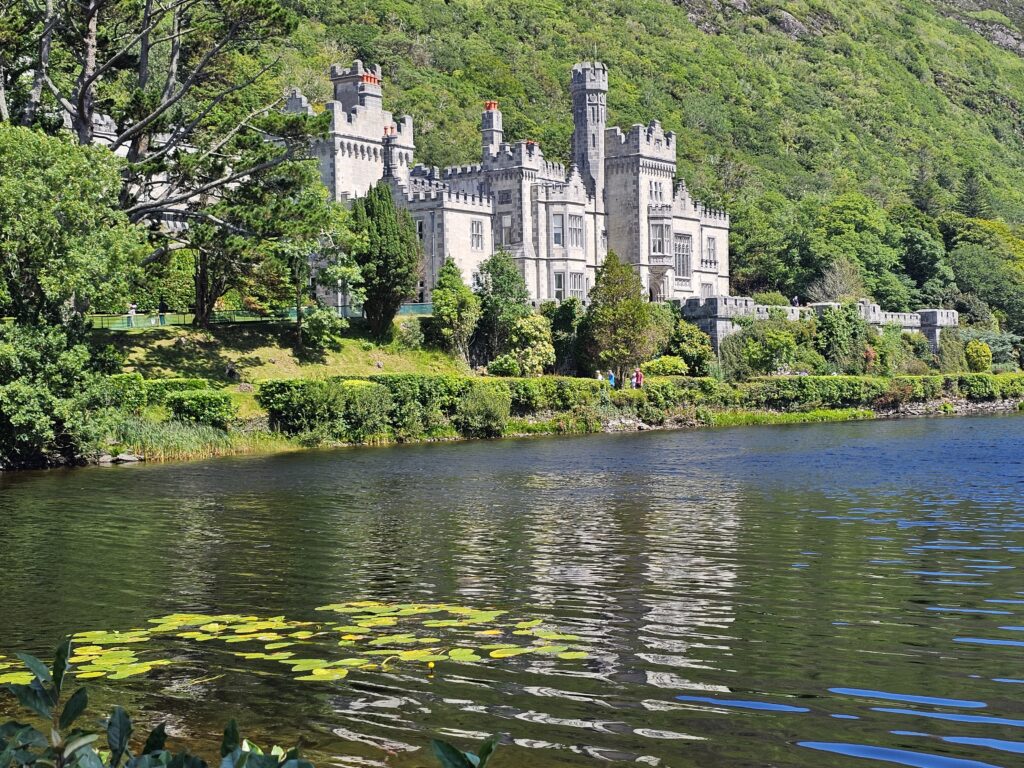
North of Clifden lies Kylemore Abbey, a neo-Gothic house set against a wooded hillside above a still lake. It is one of the most photographed spots in the west of Ireland for good reason, and the Victorian walled garden is worth the walk if the weather is kind. Kylemore Abbey is also a good place to see the famous Connemara Ponies in their daily Peaceful Ponies display. Roundstone, a fishing village to the south, is the quieter alternative for lunch and a harbour wander.
Connemara National Park and Diamond Hill
Just outside Letterfrack, Connemara National Park is where you stretch your legs properly. The walk most people come for is Diamond Hill, a well-made loop of around 7 km with roughly 500 metres of climbing. Give it two to three hours if you’re taking it easy. The reward at the top is a full sweep of the Twelve Bens, the coast and the bogland below, and it is the kind of view that quietly reorders your sense of the place. Boots rather than trainers, and a jacket regardless of what the morning looked like is our recommendation in a country where you can experience all four seasons in a day.
South to the Burren
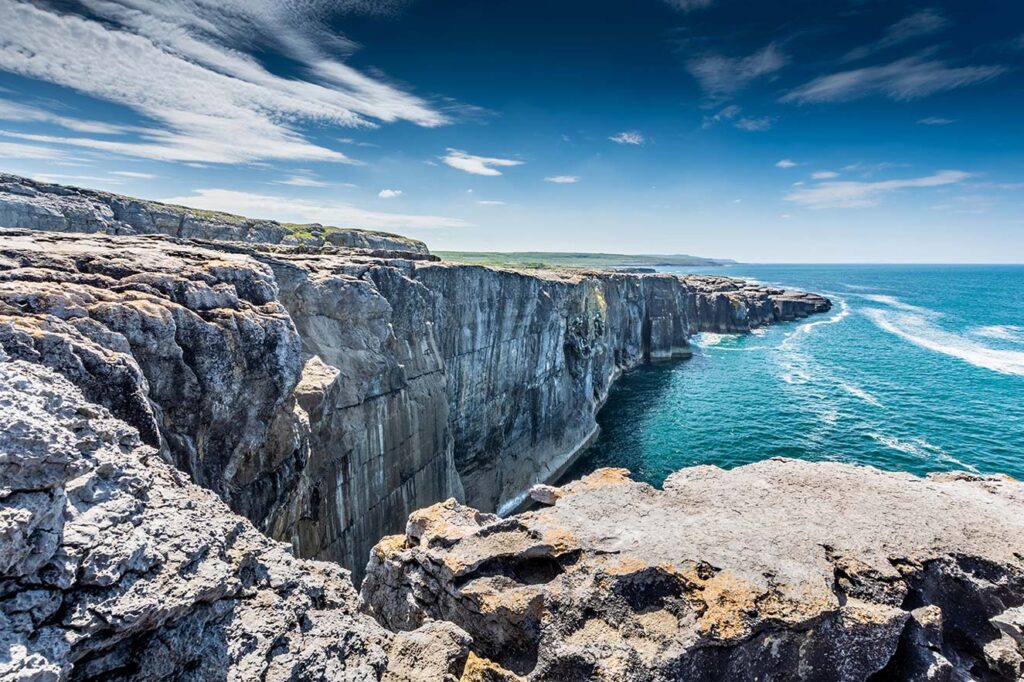
Once Connemara is behind you, ideally on a separate day, the drive south changes the mood entirely. You skirt Galway Bay through Kinvara, a pretty harbour village with Dunguaire Castle standing at the water’s edge, and then the land begins to turn to stone. You may see traditional Galway Hooker boats with their distinctive red sails and black hulls, built to withstand the strong seas here. By the time you reach Ballyvaughan the green has given way to those famous grey terraces, hillsides of bare limestone that look, at first glance, like nothing should grow there at all.
The surprise is that a great deal does. This is the paradox that makes the Burren extraordinary. In the cracks between the limestone slabs, sheltered from wind and holding warmth, grows one of the richest wildflower assemblages in Europe. If flowers matter to you, late May and June are the months to come.
The Burren’s highlights
A handful of stops carry the region, and they string together neatly on a day’s drive.
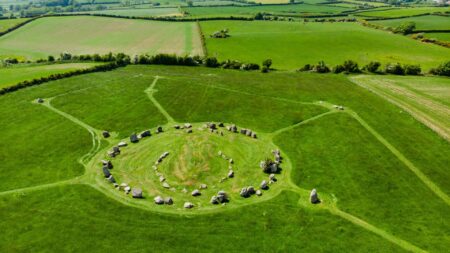
Poulnabrone Dolmen is the one you may recognise. A Neolithic portal tomb of two upright stones and a single vast capstone, standing alone on the limestone plateau, it has been there for more than 5,000 years. There is a small car park and a short walk out to it, and it is at its best in low morning or evening light.
Caherconnell Stone Fort, just down the road, is roughly a thousand years old and still remarkably intact. It runs sheepdog demonstrations through the season, which sounds like a novelty and turns out to be one of the more memorable half-hours of the trip, particularly for families.
Aillwee Cave and Doolin Cave take you underground. Doolin is home to one of the largest free-hanging stalactites in Europe, a genuinely startling thing to stand beneath, and the guided tour is well judged for all ages.
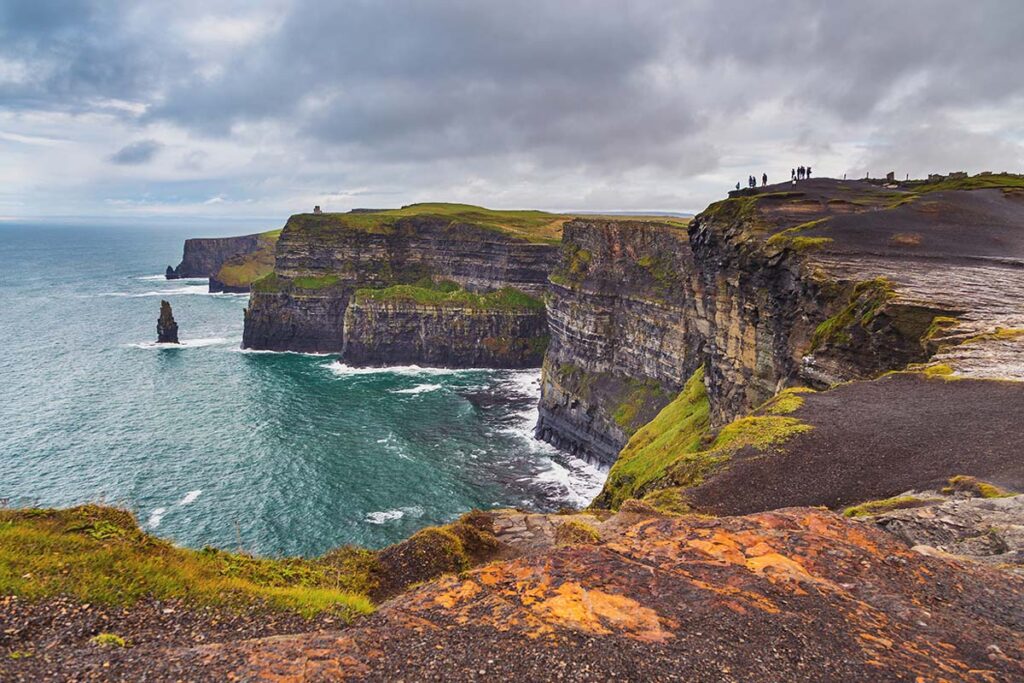
The Cliffs of Moher are the finale, rising more than 200 metres straight out of the Atlantic. They are hugely popular, so timing matters. We steer people towards the first hour after opening or the last hour before the light goes, when the coaches have thinned and the cliffs are at their most dramatic.
The Burren scenic drive
If you want a single self-contained loop, the signposted Burren scenic drive runs roughly 66 km through the interior, taking in Kilfenora, with its cathedral and high crosses, and the spa town of Lisdoonvarna. It is an easy half-day that connects the coast, the uplands and the villages, and it works beautifully as a gentler final morning before you turn back towards the airport.
Where to stay in Connemara and the Burren
We do not use large chain hotels. Across this route we place our travellers in handpicked boutique properties: a characterful base in Galway city for those who are short on time and want to see Connemara and the Burren over two days. If you have 3 or 4 days then we would recommend staying in an Irish castle hotel around Clifden or in the Kylemore valley for Connemara, and a well-chosen stay in the fishing village of Ballyvaughan for the Burren. The aim is short, sensible driving days that end somewhere you are genuinely glad to arrive, rather than a scramble between anonymous rooms. Food features heavily in our tours, and we pick hotels and inns that have places you want to stay in and dine at.
What travelling with Celtic Routes looks like
We are a bespoke self-drive company, which means the route above is a starting point, not a fixed package. A destination specialist builds your itinerary around the pace and the interests you actually have to truly personalise each trip around you.
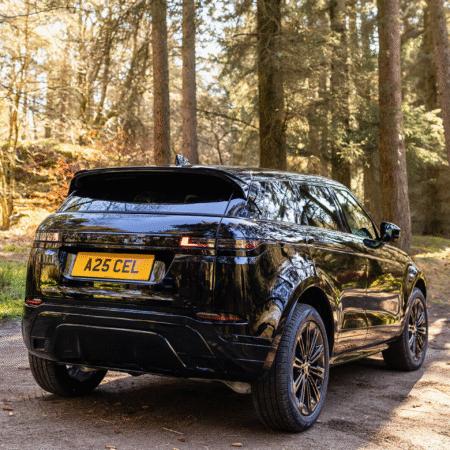
Your Land Rover is delivered to you, whether that is in Galway, Shannon, Dublin or anywhere else. All of our tours come with our app loaded with your tailored day-by-day itinerary, turn-by-turn navigation, weather and the local tips we have gathered over years of driving these roads. Behind it sits 24/7 support and full financial protection, so the practical side is quietly taken care of while you drive.
Our work has been featured in The Sunday Times and Wanderlust, and our Ireland tours start from £2,390 per person. And yes, we would say this, but for a landscape of single-track lanes, mountain passes and limestone back roads, the higher seat and the big windows of a Land Rover are not a bad way to see it.
You can read more about why people trust Celtic Routes to plan their Irish self-drive holiday
A few questions we are often asked
How many days do I need in Ireland? Two to four days for this section of the Wild Atlantic Way plus a day to get to/from the area. Most people are including this as part of a longer tour.
Which airport should I fly into? Shannon is closest to the Burren, Ireland West (Knock) suits Connemara, and Galway sits between the two. However, Dublin which is the largest airport with the highest number of flights across Europe and North America is only 2.5 hours away. We deliver the vehicle to whichever works best for you.
When is the best time to go to Ireland? Late May and June for the wildflowers and the longest days. September is quieter and often kind on the weather, but we plan trips year-round and the weather is generally mild in Ireland.
Is the driving difficult? The main roads are straightforward. Some Connemara and Burren lanes are narrow and single-track, but they are well within the reach of any confident driver, and our route notes flag the stretches worth slowing for. Our top tip is to always remember that this is your holiday so take your time – pull over if necessary and let traffic pass.
Can the route be changed? Entirely. Everything here is a template we adapt to you. Every trip is tailored to each individual client.
How much does it cost? A three day and two night tour would cost around £1,420 per person although most clients would include this in a longer tour such as our 5 night Taste of the Wild Atlantic Way which starts from £2,390 per person.
Plan your west of Ireland trip
If this is the kind of trip you have in mind, the best next step is a conversation. Book a call to plan your trip and we will shape a route around your dates, your pace and the things you most want to see. Have one of our Land Rovers delivered to your airport or hotel, handpicked boutique hotels along the way, and full financial protection throughout.
Prefer to browse first? Have a look at our Ireland self-drive tours, our Wild Atlantic Way road trip guide for the wider coastal route, or the Ring of Kerry road trip guide for the south west. Our find out why our clients consistently award us with five star reviews.